
There has never been more access to learning. From on-demand platforms to virtual classrooms and bite-sized content, knowledge is available instantly and at scale. But access alone doesn’t guarantee impact.
Most people don’t struggle to find content. The real challenge lies in applying it, turning insight into action, and ideas into consistent behaviour.
That’s why face-to-face, practical learning continues to hold real value. As organisations rethink how they develop people, it’s worth understanding why face-to-face learning continues to deliver lasting value.
From Learning to Application
Consider a manager attending a session on giving feedback. The principles may be clear: be specific, be timely, focus on behaviour. But the real test comes later, in a difficult conversation, with competing pressures, where confidence and judgement matter just as much as knowledge.
Face-to-face learning environments are designed with this in mind. They create space not only to understand concepts, but to explore how they play out in practice. Questions can be worked through in real time. Scenarios can be adapted to reflect actual workplace challenges. Learners can pause, reflect, and try again.
This is where learning begins to move from passive understanding to active capability.
The Value of Stepping Away
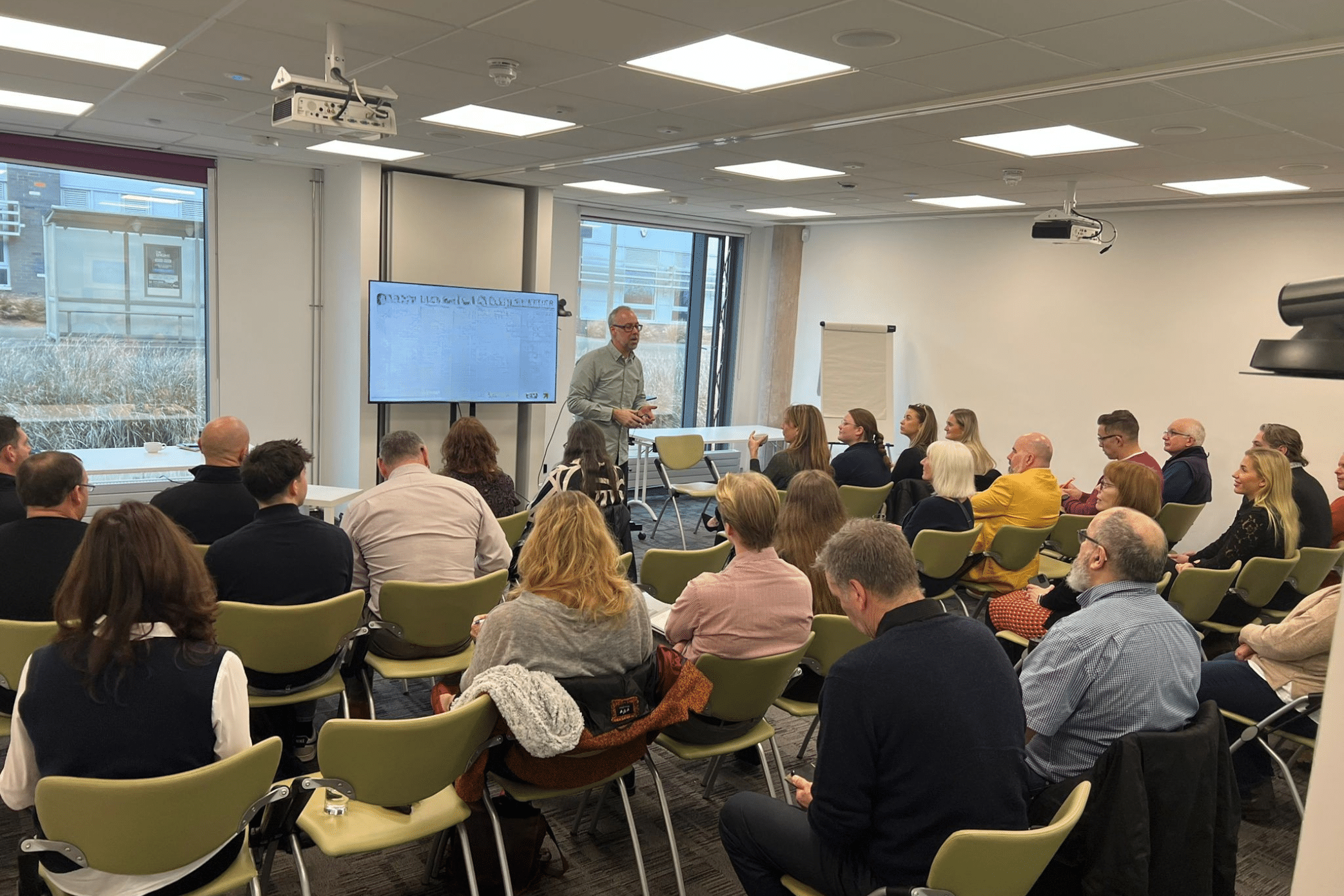
There is a distinct shift that happens when people step away from their usual environment and into a shared learning space. Time is deliberately set aside. Attention is less fragmented. Conversations are more present.
In these settings, learning becomes a collective experience. A leader from one sector may share a challenge that resonates with someone from another. For example, in a session on managing change, one participant might describe the difficulty of maintaining team morale during restructuring, while another shares how they approached a similar situation differently. The value lies not just in the content being delivered, but in the exchange of lived experience.
These interactions are often where the most meaningful insights emerge, and they are difficult to replicate in isolation.
Learning Through Practice
Certain skills cannot be fully developed through observation alone. Leadership, coaching, influencing, communication; these are skills shaped by interaction, tone, timing, and context. They require practice.
Face-to-face programmes create the conditions for that practice. Learners can role-play challenging conversations, test new approaches, and receive immediate feedback. They can observe how others respond, reflect on their own style, and refine their approach in a supportive environment.
The feedback loop is immediate and tangible. What works becomes clearer. What needs adjustment can be explored without consequence. Confidence builds not from theory, but from experience.
The Role of Expert Facilitation
The impact of any programme is shaped not only by its content, but by how that content is brought to life.
In a face-to-face setting, experienced facilitators can respond dynamically to the group. They can draw on real-world examples, adapt discussions to reflect current challenges, and explore complexity rather than simplify it.
If a conversation around performance management uncovers deeper issues around culture or trust, there is space to follow that thread. If a group needs more time to work through a particular challenge, the pace can shift.
This flexibility ensures that learning remains relevant, grounded, and immediately applicable, particularly for those operating in complex or senior roles where nuance matters.
Support Beyond the Session
One of the most valuable, and often overlooked, aspects of face-to-face learning is what it enables beyond the session itself.
Participants often leave not just with new ideas, but with connections. Peer relationships formed during programmes can continue long after the course ends, creating informal networks of support, challenge, and shared learning.
When this is combined with ongoing development, whether through coaching, mentoring, or structured reflection, the impact becomes more sustained. Learning is revisited, reinforced, and embedded into day-to-day practice.
In this sense, the most effective development is rarely a single event. It is part of a broader process in which insight is continually translated into action.
Looking Ahead
As organisations continue to invest in learning and development, the focus is beginning to shift. It is no longer just about providing access to content, but about creating experiences that genuinely change behaviour and build capability over time.
That’s not to say online learning isn’t still a great tool; it is in tandem or blended with face-to-face, and not to be used by itself, as outlined by the University of Manchester.
Face-to-face learning remains a powerful part of that equation, not as a replacement for other methods, but as a space where learning becomes real, practical, and lasting.
Taking the Next Step
For organisations thinking about how to develop their people in a meaningful way, the question is not simply what training to offer, but what kind of learning will make a difference?
We help create programmes that provide space for practice, discussion, and reflection, giving them a longer shelf life. They support individuals not just in understanding concepts, but in applying them with confidence in their own context.
Whether that takes the form of open courses, in-house programmes, or more tailored development, the principle remains the same: learning works best when it is experienced, not just delivered. Get in touch with our team to discuss your training goals.